Science

Science

— Research, discoveries, and discussion across all scientific disciplines
2 members Created Sep 2026
PH

Physics & Astronomy

1.2K threads 0 followers
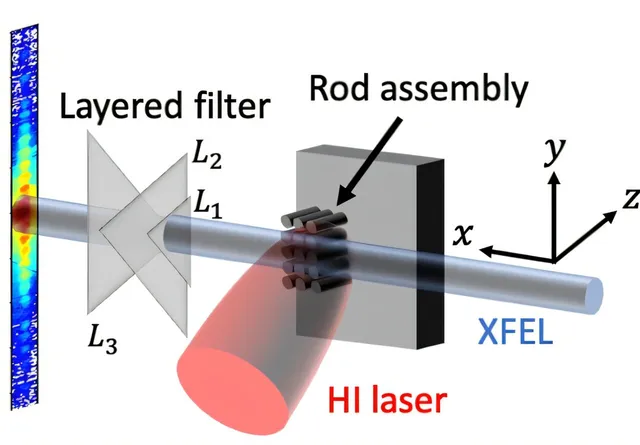
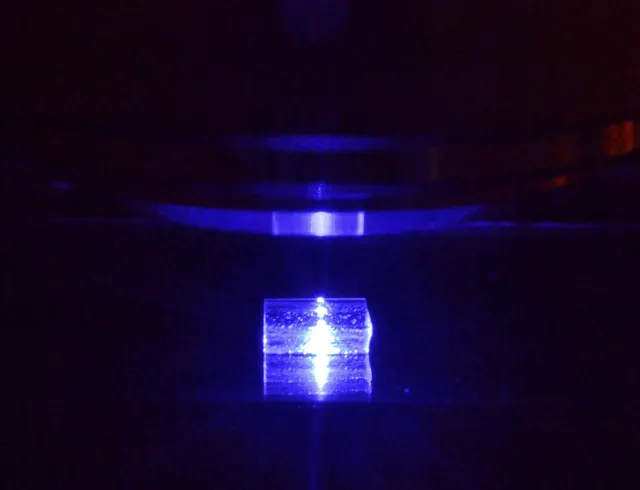
Single X-ray pulse reveals plasma nanostructures across scales with one camera

Researchers combined a beamstop-free small-angle X-ray scattering method with an X-ray free-electron laser to measure plasma structures from 10 nm to 500 nm in a single pulse with one camera. They tracked laser-driven collapse of silicon rod targets at sub-picosecond resolution, finding that a few nanometers of extra initial plasma size cuts laser absorption to about one-fourth.

— via Phys.org

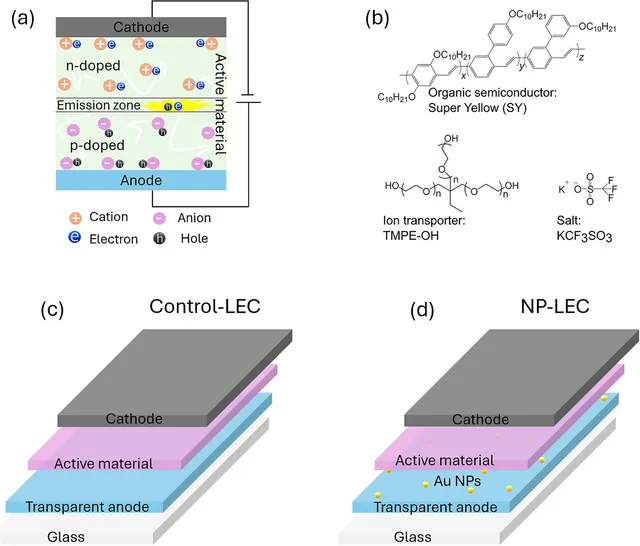
Gold nanoparticles unexpectedly alter process that controls electrical conductivity in organic devices

Umeå University researchers expected gold nanoparticles to boost light emission in light-emitting electrochemical cells, but found they instead modify electrochemical doping, which governs conductivity. This may offer a new way to control organic electronics, including transistors and bioelectronics.

— via Phys.org

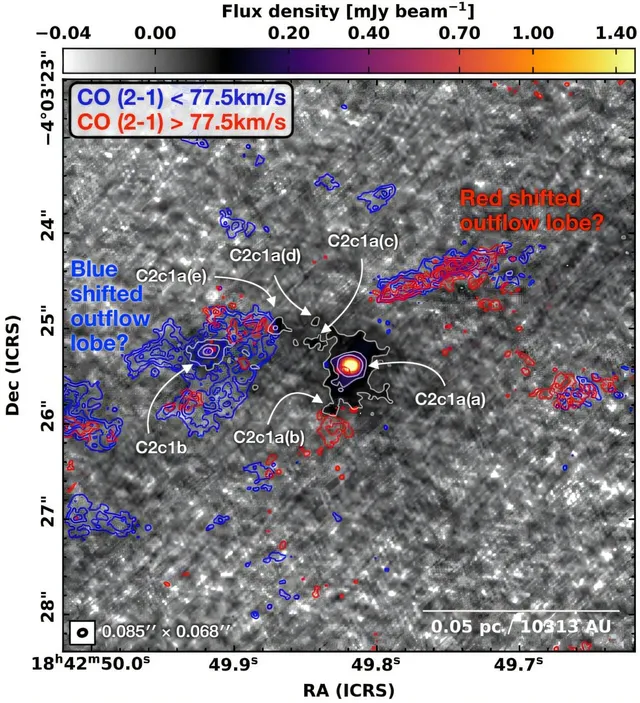
ALMA spots 'dragon egg' that may represent the earliest stages of massive star formation

Astronomers using ALMA observations identified a compact core nicknamed the "dragon egg" in the infrared-dark Dragon Cloud, about 16,300 light-years away, that may represent a very early stage of massive star formation. The core holds roughly 20 to 30 solar masses, but the data cannot yet distinguish between competing formation models.

— via Phys.org

Automated identification and subtraction of gravitational-wave glitches using boundary refinement

Researchers present three methods (AMPS, FLARE, CRISP) that identify the time boundaries of noise glitches in LIGO data, paired with spline and wavelet subtraction techniques. In injection tests on broadband glitches, the combined technique recovered 95 to 97 percent of the injected signal-to-noise ratio, versus about 64 percent for wavelet shrinkage alone.

— via arXiv — Astro-ph, Mohammad Abu Thaher Chowdhury

Isochrone fitting of Galactic globular clusters - IX. Tip of the red-giant branch for 27 clusters and constraints on new particle physics

Using tip-of-the-red-giant-branch measurements for 27 globular clusters, with 24 in the main likelihood, researchers constrain the axion-electron coupling to g_ae below 6.4e-14 at 95% CL. The observed TRGB was fainter than standard cooling predicted, by about 0.078 mag.

— via arXiv — Astro-ph, G. A. Gontcharov, A. M. Kudashov, O. S. Ryutina, S. V. Troitsky

Efficient Eccentric Effective-One-Body Dynamics via Near-Identity Averaging Transformations

Researchers present a way to speed up eccentric effective-one-body models of black hole binary inspirals by averaging away fast orbital oscillations. Inspiral dynamics cost drops by up to two orders of magnitude, overall waveform generation is 1.5-8 times faster, and mismatches stay at or below 8.05e-5.

— via arXiv — Astro-ph, Philip Lynch, Alessandra Buonanno, Aldo Gamboa, Maarten van de Meent

Light-based method enables precise control of ultrafast electron flow in a scanning tunneling microscope

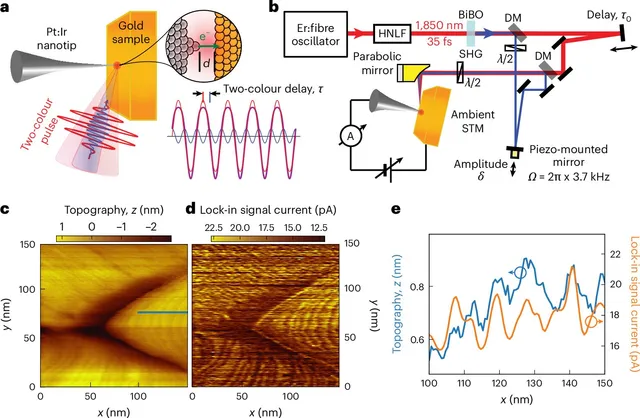
A Technion-led team used two-color infrared laser pulses in a scanning tunneling microscope to steer the direction of electron flow across the tip-sample gap. By tuning pulse timing, they reconstructed current bursts of 860 attoseconds while keeping roughly two-nanometer sideways resolution at room temperature and in air.

— via Phys.org

Core Composition Effects on the QCD Axion Mass Limit from Neutron Star Cooling

Researchers examined how the neutron-star-cooling limit on the QCD axion mass (KSVZ and DFSZ models) changes when heavier particles such as hyperons and Delta resonances are allowed in the core. The dependence is generally mild, reinforcing the known limit, though in the DFSZ case it may bring the limit into IAXO's sensitivity window.

— via arXiv — Astro-ph, Fernando Arias-Arag'on, Federico Nola