Atlantic Council experts analyze the planned Shenzhen meeting of Trump, Putin and Xi, saying its agenda is fluid and may include nuclear arms, Iran and Ukraine. They describe distinct aims: Putin seeks great-power recognition, Xi wants a controlled showcase and Trump emphasizes optics and possible deals.
International relations, foreign policy, and global power dynamics
A CFR analysis argues that U.S. critical minerals funding is flowing but lacks a lasting political constituency to sustain supply chains. It cites Ford's weeklong Chicago assembly halt in May 2025 over China's rare-earth magnet licensing and proposes pooled demand, coinvestment and portfolio scorecards.
An issue brief argues that attacks on merchant shipping in the Strait of Hormuz, Red Sea, Black Sea and other strategic waters have made the oceans less safe than at any point in three decades. It says Russia, Iran and the Houthis have targeted vessels as a geopolitical tool while shipping companies adapt to the risks.
A War on the Rocks analysis says quiet resignation is a narrow military norm for lawful but objectionable orders, not illegal ones, and mainly for flag officers. It critiques advice reportedly given to Gen. Dan Caine that a commander should retire quietly after an unlawful order, while doubting the reporting's accuracy.
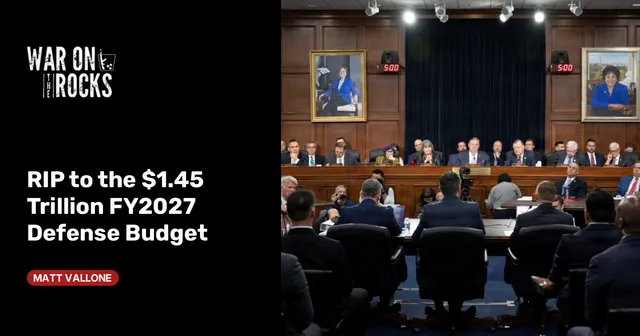
The 2026 midterms and a cramped lame-duck calendar likely end the Trump administration's proposed $1.45 trillion FY2027 defense budget, especially its $350 billion reconciliation portion. A $1.1 trillion base request may still be salvageable, while Congress faces appropriations, an Iran war supplemental and another possible continuing resolution.
Researchers at MinoHealth AI Labs in Accra removed safeguards from a drug-discovery AI model in 2024 and asked it for toxins; it produced designs for 1,020 proteins and 5,000 small molecules that toxicity-prediction software scored as likely toxic, though none were synthesized. The preprint, discussed within Interpol, has fed calls in Africa to regulate DNA synthesis providers.
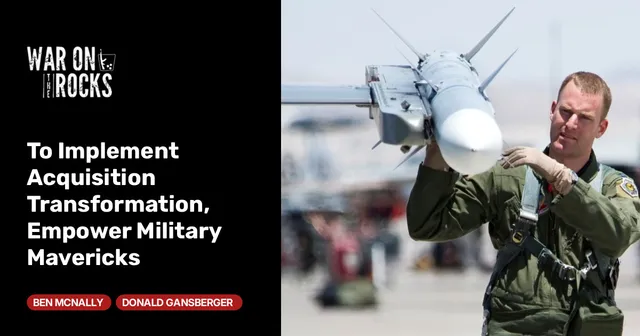
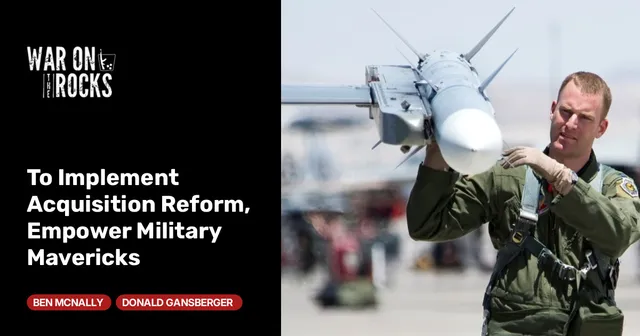
The article proposes making the Defense Innovation Unit a weapons school for commercial technology acquisition, where selected service members would receive rigorous training and then return to their services to lead and teach. It grounds the proposal in the unit's experience since 2016 and recent Pentagon memos that prioritize commercial-first buying.
The Trump administration requested $1.5 trillion in defense spending, called the largest ask in history, as rising debt and midterm results intensify a possible lame-duck budget fight. Former Pentagon innovation chief Doug Beck discusses how the military can adopt AI, drones and other technologies faster.
Five former defense secretaries have told Congress they are deeply alarmed by Pete Hegseth's remaking of the U.S. military, and two retired flag officers say his personnel decisions and attacks on diversity programs are hurting recruitment, retention and the force's nonpolitical ethos.
The article argues that the postwar convergence of poorer economies depended on labor-cost, market-access, and regulatory arbitrage. It contends that security-driven trade restrictions, subsidies, sanctions, and climate rules are closing those gaps, making catch-up growth harder and less evenly distributed.
Despite the Democratic midterm landslide, Trump retains broad latitude over U.S. foreign policy because he has routed around congressional and judicial constraints and Democrats lack veto-proof margins, the author argues. A wounded Trump may sharpen rather than soften America First, with Iran and Cuba as possible next tests.
Zongyuan Zoe Liu argues that postwar convergence between poorer and advanced economies relied on favorable trade, investment and security conditions, especially for East Asian late industrializers. She says security concerns, subsidies, sanctions and climate-related trade rules are closing the arbitrage gaps that once helped developing countries industrialize.
Nvidia CEO Jensen Huang resigned Thursday after reports surfaced of extramarital affairs, one involving a suspected Chinese spy. Atlantic Council experts said his departure could affect US chip export controls, Nvidia's market standing and a planned Trump-Xi meeting.
China is building overlapping cross-border payment channels—an interest-bearing e-CNY framework, CBETS, mBridge and an expanded CIPS—to deepen renminbi use and lessen reliance on dollar infrastructure, though retail e-CNY adoption remains weak. CIPS processed 7.7 million transactions worth 182.8 trillion renminbi from January through October, and the PBOC governor argued that counting such settlements raises the renminbi’s international payments share.
The authors argue that forward-deployed biomanufacturing could let military forces produce fuels, food and materials nearer the front, reducing reliance on fragile supply lines. They urge the Pentagon to coordinate specialized firms and demonstrate deployable systems, while noting technical and feedstock limits.
At a G20 Interfaith Forum in Salt Lake City, leaders from more than fifty countries and thirty-five religious traditions pressed for cooperation to ease suffering and advance peace ahead of the G20 summit in Miami. The author cites Utah's charitable giving and immigration compact as models, while noting U.S. refugee admissions fell to 16,292 last fiscal year.
Nvidia is investigating allegations that a Chinese intelligence operation targeted CEO Jensen Huang, who acknowledged an affair and said he would cooperate with the board's probe, which found no reason to believe secrets were compromised. China's foreign ministry rejected the reporting as groundless speculation.
The article argues the next Congress should use the fiscal 2027 defense authorization bill to repair military personnel policy, citing a survey in which 53 percent of active-duty respondents said they were considering separating early. It calls for protecting vetted officers from removal from promotion lists without notice or appeal and for barring gender-based exclusion from combat roles.
An Atlantic Council report contends that Mediterranean water planning must now weigh industrial, urban and digital demand, especially data centers, alongside agricultural needs. It calls for blended finance and public-private partnerships, and proposes screening projects for trade-offs before the COP31 talks in Antalya.
Arguing the Pentagon holds commercial buying authorities but has too few people trained to use them, a former Defense Innovation Unit warfighter-in-residence and a co-author urge remaking the unit as a weapons school for commercial technology acquisition. They cite its 2016 commercial solutions opening process and 2024 awards, including a $392 million drone-boat contract to Saronic Technologies.